


Lab-Grown vs Natural Diamonds: Price, Resale Value, and Which One to Buy

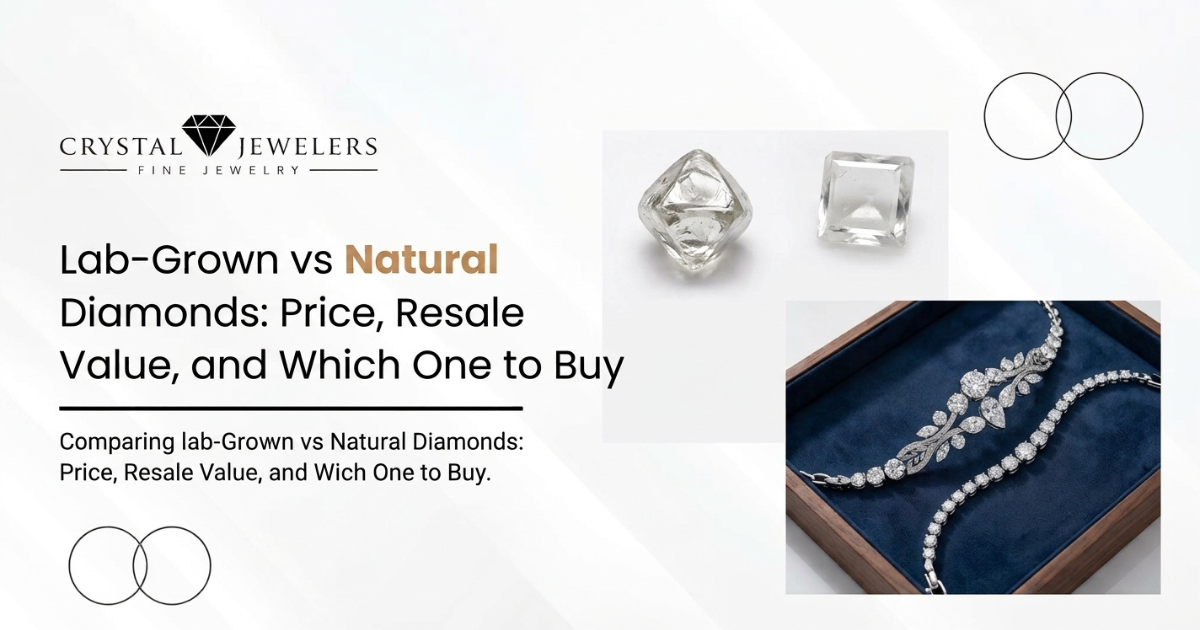
A lab-grown diamond and a natural diamond are both real diamonds. They have the same makeup, the same hardness, and the same sparkle. The big differences are where they come from, how much they cost, and how much money you can get back if you sell one later.
If you want more size and sparkle for your budget, lab-grown is often the better fit. If you want a stone that formed in the earth and may resell for more, natural may be the better fit. Below, we explain each choice in plain words so you can decide with confidence.
Quick Answer: Lab-Grown vs Natural at a Glance
| Question | Lab-grown diamond | Natural diamond |
|---|---|---|
| Is it a real diamond? | Yes | Yes |
| How is it made? | Grown in a lab in a few weeks | Formed in the earth over billions of years |
| Price | Often 60 to 85 percent lower | Higher |
| Looks | Same as natural to the eye | Same as lab-grown to the eye |
| Hardness | 10 on the Mohs scale | 10 on the Mohs scale |
| Resale value | Low | Higher, but still below retail |
| Best for | Bigger size, better clarity, lower cost | Buyers who want a stone from nature |
What Is a Lab-Grown Diamond?
A lab-grown diamond is a diamond made by people in a controlled space. Makers start with a tiny diamond seed. Then they use heat and pressure, or a special gas process, to grow a new diamond around it.
Two main methods are used. One is called HPHT, which stands for high pressure, high temperature. The other is called CVD, which stands for chemical vapor deposition. You do not need to remember these names. What matters is that the end result is a diamond, not a fake stone.
That last point is where many shoppers get confused. Cubic zirconia and moissanite are look-alike stones. A lab-grown diamond is not a look-alike. It is a diamond.
What Is a Natural Diamond?
A natural diamond formed deep in the earth under very high heat and pressure. It took a very long time. Miners then bring it up, and cutters shape it into the sparkling stone you see in a ring.
Because nature makes a limited number of them, natural diamonds are seen as rare. That rarity is a big reason they cost more.
Do They Look Different?
No. To the naked eye, they look the same. Even most jewelers cannot tell them apart by looking. Special tools are needed to check where a diamond came from.
Both types can have tiny marks inside called inclusions. Both can have a little color. Both are graded on the same scale: cut, color, clarity, and carat weight. If you want to learn how cut changes the shine, read our guide to diamond shapes and which cut to pick.
How Much Cheaper Is a Lab-Grown Diamond?
Lab-grown diamonds usually cost far less than natural diamonds of the same size and quality. Many sellers report savings of 60 to 85 percent. Prices change over time, so always ask for a current quote.
Here is a simple way to think about it. A budget that buys a one-carat natural diamond may buy a two-carat or even a three-carat lab-grown diamond. That is a big jump in size for the same money.
Why is the price lower? Growing a diamond in a lab skips mining and a lot of shipping. It also takes weeks, not billions of years. As the technology gets better, the cost to make one keeps going down.
What people do with the savings
Many buyers do not spend less. They spend the same and get more. Here are common choices:
- Pick a larger center stone
- Choose a higher clarity or color grade
- Upgrade the metal from white gold to platinum
- Add a matching wedding band
- Put the extra money toward the wedding or a honeymoon
If you are shopping for a ring, our guide to diamond rings under $5,000 shows how far a budget can go. Curious about size? See what a 5 carat diamond ring looks like on the hand.
Resale Value: The Part Most Shops Skip
This is the honest part of the story. Neither type is a good way to grow your money. Diamonds cost more at the store than a buyer will pay you later. That is true for any diamond.
Here is how it usually plays out:
- Natural diamonds often sell back for a fraction of the retail price. Many sellers say about a third to a half, but it depends on the stone and the buyer.
- Lab-grown diamonds usually sell back for much less. Prices for them have dropped over the years, and more supply keeps coming.
So are lab-grown diamonds worth it? For most people who plan to wear the diamond and keep it, yes. You pay less up front and get a beautiful stone. But if you think of your ring as something you may sell in a few years, natural holds its value better.
A simple test can help. Ask yourself, “Will I keep this for life?” If the answer is yes, resale matters less. If the answer is maybe not, ask more questions before you buy.
Durability: Will a Lab-Grown Diamond Wear Out?
No. Both types score a 10 on the Mohs hardness scale. That is the top score. A lab-grown diamond will not scratch, cloud, or fade any faster than a natural one.
Both still need care. Diamonds attract oils and lotion, so they look dull when they get dirty. Here is how to fix that at home: how to clean a diamond ring at home.
Also remember that hard does not mean unbreakable. A hard hit on the edge of a stone can chip it. Choose a setting that protects the diamond if you work with your hands.
Certificates: Proof of What You Are Buying
A grading report lists the size, color, clarity, and cut of a diamond. It is like a report card. For lab-grown stones, the report also states that the stone was grown in a lab. Many lab-grown diamonds also have a tiny laser mark on the edge that matches the report number.
Two well-known labs are GIA and IGI. Each has its own style. We explain the difference in our post on GIA vs IGI diamond certification. If you buy a loose stone or a large center stone, ask for a report.
Ethics and Environment
Many shoppers care about how a diamond is made. Lab-grown diamonds do not come from a mine, so they avoid the land damage and worker safety worries linked to some mining. Many buyers like that.
That said, growing a diamond uses a lot of power. How green a lab-grown diamond is depends on how the lab gets its energy. If this matters to you, ask the seller where the stone was made. A good jeweler will answer honestly or tell you they do not know.
Natural diamond sellers also work to improve sourcing. Ask for the paperwork, and do not be shy about it.
Which One Should You Buy?
There is no one right answer. Use this list to find your fit.
Choose lab-grown if you:
- Want a bigger diamond for your money
- Care more about how it looks than what it might sell for
- Want fewer flaws inside the stone for a lower price
- Like that it does not come from a mine
- Plan to wear it every day and keep it
Choose natural if you:
- Like the idea of a stone that formed in the earth
- Want the best chance of getting some money back later
- Are buying an heirloom or a family gift with a special story
- Prefer the traditional choice
Still unsure?
Try both on. Seeing two stones side by side often ends the debate. At Crystal Jewelers, you can look at different options in person and ask questions with no pressure. You can also book a time through our engagement and wedding jewelry appointment page.
Lab-Grown Diamonds Beyond Engagement Rings
Lab-grown stones are not only for rings. Because they cost less, they make big sparkle more reachable in everyday jewelry. Popular picks include:
- Lab-grown diamond solitaire earrings for a classic look
- A lab-grown diamond bracelet for a special day or every day
- A matching bridal ring set for the wedding
You can also browse our full rings collection to see current styles.
Five Mistakes to Avoid When You Compare
- Buying by carat alone. Two diamonds of the same size can look very different. Cut quality matters a lot.
- Skipping the report. For a center stone, ask for a grading report from a known lab.
- Thinking “lab-grown” means “fake.” It does not. It is a real diamond.
- Expecting a big payback later. Any diamond will sell for less than retail.
- Ignoring the setting. A weak setting can put a great diamond at risk. Ask how the stone is held.
How to Pay for It
A diamond is a big purchase. If you want to spread out the cost, there are options. Read our guide to jewelry financing in Greensboro to compare plans before you shop. Always read the terms, and choose a payment you can handle.
Shopping for Diamonds in Greensboro and the Triad
Crystal Jewelers is a family-owned jewelry store in Greensboro, NC. Many customers visit from High Point, Winston-Salem, Burlington, and Kernersville to look at diamond jewelry in person. Trying a stone on your hand is the best way to know how it looks in real life. If you want help finding a store you can trust, read our tips on how to find a trusted jeweler in Greensboro. You can also learn more about us or contact us with questions.
Frequently Asked Questions
Yes. A lab-grown diamond has the same makeup and hardness as a natural diamond. The only difference is where it was made.
For most people who want to wear their diamond and keep it, yes. You get more size and quality for your money. The trade-off is that resale value is lower.
Not as well as natural diamonds. Lab-grown prices have dropped over time because more of them are made. No diamond is a sure way to make money, so buy one because you love it.
Not by eye. Jewelers use special testing tools to tell the two apart. A grading report will also state which type the diamond is.
Yes. They are often 60 to 85 percent less for a similar size and quality, though prices change.
No. A lab-grown diamond is as hard as a natural one. Clean it now and then, and it will keep its sparkle.
The Bottom Line
Lab-grown and natural diamonds are both real. Lab-grown gives you more diamond for less money. Natural may keep more of its value if you ever sell. Think about how you will use the ring or jewelry, and pick the one that fits your life and your budget.
Ready to look? Visit Crystal Jewelers in Greensboro, try on a few options, and ask us anything. We are happy to help you find a diamond you will love for years.