


GIA vs IGI: What Is the Difference and Does It Matter?

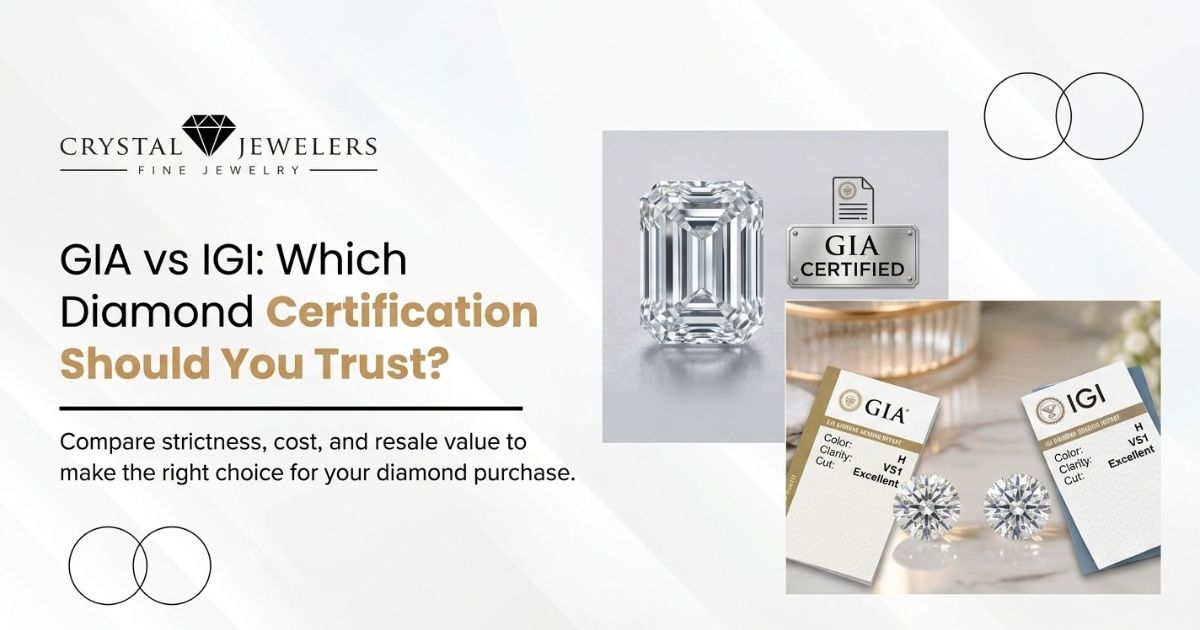
If you are shopping for a diamond, you will probably see the letters GIA or IGI printed on the certificate. Both are real, respected grading labs. But they are not the same, and the difference can actually affect what you pay and what you get. Here is what you need to know before you buy.
What Is a Diamond Certification, Exactly?
A diamond certification, also called a grading report, is a document created by an independent lab. A trained gemologist examines the diamond and records its carat weight, color, clarity, and cut, often called the 4Cs. This report tells you exactly what you are paying for and gives you something to compare if you ever want to resell or insure the diamond.
What Is GIA?
GIA stands for the Gemological Institute of America. It was founded in 1931 and is a nonprofit organization. GIA is widely seen as the most conservative and consistent lab in the industry. That means if GIA says a diamond is a certain color or clarity grade, that grade tends to hold up no matter which GIA office looked at it. Many jewelers, buyers, and appraisers treat a GIA report as the gold standard, which is part of why GIA certified diamonds often carry a slightly higher price on the resale market.
What Is IGI?
IGI stands for the International Gemological Institute. It was founded in 1975 and operates as a for-profit company. IGI is known for being accessible and detailed in its reports, and it has become the leading lab for grading lab grown diamonds. Being for-profit does not make IGI’s grading inaccurate, but it does tend to grade slightly more generously than GIA. In practice, this means a diamond graded as a certain color or clarity by IGI might receive a slightly lower grade if it were sent to GIA instead.
The Real Differences Between GIA and IGI
- Grading strictness. GIA is known for being more conservative. IGI’s grades can run a little higher for the same diamond, especially on color and clarity.
- Lab grown diamonds. IGI has become the go-to lab for lab grown diamonds and grades the full 4Cs on them. GIA also certifies lab grown diamonds but uses a slightly different, more descriptive grading scale for them rather than the standard color and clarity grades used for natural stones.
- Cost of certification. IGI reports typically cost less to obtain than GIA reports. This can make IGI certified diamonds a bit more affordable for the same stated grade, since the certification cost is often built into the diamond’s price.
- Resale value. Because GIA is viewed as the stricter, more universally trusted standard, GIA certified natural diamonds tend to hold their resale value a bit better than IGI certified diamonds of the same stated grade.
- Global recognition. Both labs are recognized worldwide, but GIA has a longer track record and is often the first name jewelers and appraisers mention when discussing trusted grading.
Which One Should You Choose?
- Choose GIA if: You want the most consistent, conservative grading available, you plan to resell or pass the diamond down as an heirloom, or you simply want the most widely recognized name on your certificate.
- Choose IGI if: You are buying a lab grown diamond, since IGI is the leader in that space, or you want a detailed, trustworthy report at a more accessible price point.
Neither choice is wrong. Both labs are legitimate, and both will tell you the truth about your diamond’s basic qualities. The right pick depends on your budget, whether your diamond is natural or lab grown, and how much weight you place on resale value.
A Simple Tip Before You Buy
Do not compare a GIA graded diamond and an IGI graded diamond side by side using only the printed grade. Because IGI can grade a notch more generously, a diamond listed as IGI “VS1” might look closer to a GIA “VS2” in person. Whenever possible, view the diamond in person, or ask your jeweler to explain how the two labs compare on the specific stone you are considering.
Frequently Asked Questions
Yes. IGI is a legitimate, internationally recognized grading lab. Its grading is reliable, though it tends to run slightly more generous than GIA on natural diamonds.
Neither is universally better. GIA is stricter and more traditional, which suits natural diamonds and resale value. IGI is strong for lab grown diamonds and tends to be more affordable.
Often, yes, for a diamond with the same stated grade, because GIA certification costs more to obtain and carries more weight in the resale market.
It is much harder to know exactly what you are buying without a certification. A grading report from GIA or IGI protects you by giving an independent, third party record of the diamond’s quality.
Yes. Certification matters for lab grown diamonds just as much as natural ones. IGI is currently the most common lab for grading lab grown stones.
Ready to Find Your Diamond?
Our team in Greensboro can walk you through certified diamonds from both GIA and IGI so you can pick the right stone with full confidence. Browse our loose diamonds, explore our diamond collection, or check out our guide to diamond shapes and cuts to get the full picture before you shop.
Want a certified diamond built into a custom setting? Book a custom jewelry appointment and we will help you choose the right stone and certification for your budget and your style.